
PEMF, Kinesiology Taping, Laser… Where Do I Start?
PEMF, laser therapy, red light therapy, kinesiology taping and therapy plates!
These are some of the terms you’ll regularly hear mentioned on social media, in horsey conversations and on therapists’ websites. They often appear alongside photos of horses wearing brightly coloured tape, standing on vibrating platforms or wrapped in futuristic-looking rugs. Some people swear by them but Others dismiss them completely. However, if you’re a horse owner trying to make sense of it all, it’s easy to wonder whether your horse is missing out on something, or whether it’s all just clever marketing.
The truth, as always, sits somewhere in the middle. First things first…
One of the biggest misconceptions is thinking these are professions. They’re not. Nobody qualifies as a “PEMF therapist” in the same way someone qualifies as a Veterinary Physiotherapist or an Equine Sports Massage Therapist. PEMF, laser therapy, red light therapy, kinesiology taping and therapy plates are all modalities. In simple terms, a modality is another tool that an appropriately trained professional may choose to use alongside their assessment, hands-on treatment and rehabilitation programme. Think of it like a carpenter building a stable door. They don’t use one tool for every job. They might use a saw, a drill, a chisel or a plane depending on what they’re trying to achieve. The tools don’t make them a skilled carpenter. Knowing which tool to use, when to use it and when not to use it is what makes the difference. It’s exactly the same with equine professionals. Physiotherapists, ESMTs, Chiropractors and Osteopaths may choose to use one or a combination of modalities while others don’t use any additional modalities at all.
Neither approach is automatically better. The important thing is that any treatment is based on a thorough assessment of the horse in front of them. It’s never about the machine and should not replace a professional using their hands, however the different modalities can be useful tools to support your horse, as and where the professional and team around your horse has deemed them appropriate to use. A good therapist using knowledge, skills and clinical reasoning to assess when it is right to use a particular modality, and equally, when it is not appropriate. In fact, some of the best therapists I know have a very simple philosophy. They don’t use a piece of equipment because they own it, they use it because, after assessing the horse, they believe it’s appropriate for that individual for that specific reason. Sometimes they won’t use any equipment at all and sometimes the most valuable part of an appointment is the assessment itself.
With this in mind, let’s look at the most common modalities (there are many more in existence beyond this article) you may have seen and how they can benefit your horse.


Common Modalities
Kinesiology taping
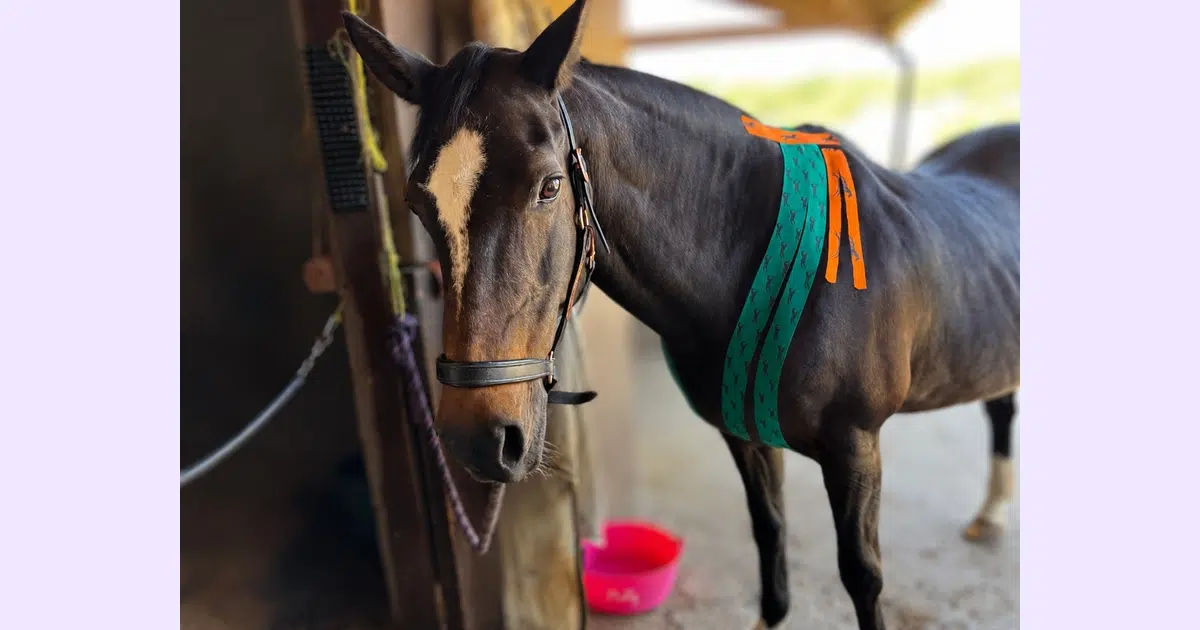
One of the most recognisable modalities is kinesiology taping. I know in a personal capacity as someone who regularly runs long distances, the huge benefits it brings. You may have seen brightly coloured strips of tape running across a horse’s shoulder, hindquarters or back and wondered what they actually do. Equine kinesiology taping has become an increasingly valuable part of many horses’ rehabilitation, performance, wellbeing and maintenance programmes. It’s a non-invasive, drug-free modality that can be used alongside other therapies such as massage, physiotherapy, chiropractic and osteopathy, or as part of a wider veterinary-led management plan.
Depending on the individual horse and the reason for treatment, kinesiology tape may be used to:
• Support recovery after exercise
• Assist rehabilitation following injury
• Encourage more efficient movement patterns
• Help reduce muscle tension
• Improve proprioception (the horse’s awareness of where its body is in space)
• Provide gentle support around joints without restricting movement
Research has also suggested it may help reduce discomfort by creating an analgesic effect and reducing pain sensitivity. What many horse owners don’t realise is that applying tape correctly requires far more than simply copying a picture from the internet. The therapist needs to understand anatomy, biomechanics, the horse’s movement, the purpose of the application and whether taping is actually appropriate in the first place. Training providers such as Equine K Taping UK offer workshops across the UK, as well as more comprehensive courses, helping equine professionals develop the knowledge and practical skills needed to use kinesiology taping safely and effectively.
PEMF (Pulsed Electromagnetic Field Therapy)
PEMF has become increasingly popular over the last few years, with a growing number of portable devices now available to both professionals and horse owners. The technology uses pulsed electromagnetic fields and is used by some therapists as part of rehabilitation, performance and maintenance programmes. Research into PEMF in horses is still developing. While some studies have shown promising results for particular applications, the evidence varies depending on the condition being treated and more research is being done in this area. Watch this space! A good therapist won’t simply reach for PEMF because they own the equipment. They’ll consider whether it’s appropriate for your horse and whether it’s likely to complement the overall treatment plan.
Laser therapy
Laser therapy is another modality that’s becoming increasingly common in equine rehabilitation. It uses light energy and may be incorporated into treatment programmes by appropriately trained professionals, but did you know that not all lasers are the same? You may hear terms such as Low Level Laser, Class 3B or Class 4 Laser. These describe different types of therapeutic lasers with different power outputs and safety classifications. RCVS-registered veterinary surgeons and trained veterinary physiotherapists or paraprofessionals working under direct veterinary delegation/referral can use Class 3B and Class 4 lasers on equines. Lasers can aid tendon and ligament repair, pain and arthritis relief, relieve deep muscle spasms and tightness in the back and neck and aid wound healing.
Red light therapy
Red light therapy, sometimes called photobiomodulation, uses red and near-infrared light. You’ll often see horses standing in front of large red light panels or wearing specialist therapy pads. As with laser therapy, some professionals incorporate red light therapy into rehabilitation or maintenance programmes where they feel it’s appropriate. Research in this area continues to grow, but effectiveness depends on factors such as dosage, treatment frequency and the condition being managed.
Balance pads
Balance pads are another modality you may come across during your horse’s rehabilitation or conditioning programme. Made from high-density foam, they create a slightly unstable surface for the horse to stand on. The idea is that this encourages the horse to make small postural adjustments, engaging different muscles and increasing awareness of where their body is in space, a process known as proprioception. Depending on the individual horse and the reason they’re being used, balance pads may be incorporated into rehabilitation programmes, exercises designed to improve core stability or as part of a general conditioning routine. Although they might look simple, they’re not a case of standing your horse on a piece of foam and hoping for the best. A trained professional will consider factors such as your horse’s age, fitness, balance, existing injuries and confidence before deciding whether balance pads are appropriate and how they should be introduced.
Therapy plates
Whole body vibration platforms, often known simply as therapy plates, are used by some professionals to support muscle activation, balance and conditioning. Some horses appear to tolerate them very well, while others may not be suitable candidates. As with every modality, individual assessment is key.
Therapeutic ultrasound
Therapeutic ultrasound shouldn’t be confused with the ultrasound scans your vet might use for diagnosis. Instead, therapeutic ultrasound delivers sound waves into tissues and may be used by some professionals as part of soft tissue rehabilitation programmes. Whether it’s appropriate depends entirely on the horse and the condition being treated.

Questions every horse owner should ask
Does newer always mean better?
The equestrian industry loves innovation. Every year there’s a new piece of equipment, another rug, another gadget or another therapy that’s said to be the next big thing. Some of those innovations genuinely do become valuable additions to professional practice while others need more research. Some may prove useful in certain situations but not others. The important thing is not to assume that because something is new or expensive, it must automatically be better. Sometimes the greatest value in an appointment has nothing to do with equipment at all. It’s the therapist noticing that your horse has developed asymmetry since the last visit. It’s recognising that the saddle no longer fits. It’s identifying something that needs veterinary investigation. It’s giving you exercises to complete between appointments. It’s answering your questions and helping you understand your horse better.
If a therapist recommends a particular modality, don’t be afraid to ask why.
A good professional will welcome your questions.
You might ask:
• Why have you recommended this modality for my horse?
• What are you hoping to achieve?
• What training have you completed in using it?
• Will it be used alongside other treatment?
• How will we know whether it’s helping?
The answers should make sense to you and be explained in an understandable way. If they don’t, ask again. One thing I’ve learnt through being a horse owner myself and through reading The Equestrian Business Award nominations when I shortlist, is that horse owners don’t just get confused by different professions, they’re often overwhelmed by the sheer number of therapies available too. That’s one of the reasons I created Equinnect. Our aim isn’t to tell horse owners which modality is “best” or to promote one profession over another. Instead, we focus on helping horse owners find professionals whose qualifications, insurance and ongoing Continuing Professional Development (CPD) have been independently verified. While while a modality may be one of the tools a professional chooses to use, it’s their knowledge, experience and ability to assess your horse that really makes the difference.
There isn’t a magic machine that suits every horse. There isn’t one modality that’s right for every situation and there certainly isn’t a substitute for an experienced professional who knows how to assess a horse properly and choose the most appropriate approach.
Whether your horse’s programme includes massage, rehabilitation exercises, kinesiology taping, laser therapy, PEMF or no additional modalities at all, the most important thing is that it’s tailored to your horse as an individual. The aim of Equinnect is to not only empower horse owners to advocate for their horse, but to also provide a network of independently Verified Professionals who uphold high standards of horse welfare, continuous professional development and client support. If you’re ever unsure where to start, remember that choosing the right professional is far more important than choosing the latest piece of equipment. Look for the Equinnect Verified Member logo for added peace of mind that the professional’s qualifications, insurance and ongoing Continuing Professional Development (CPD), where applicable, have been independently verified. It takes some of the guesswork out of finding someone you can trust.
Find a trusted professional at www.equinnect.co.uk
Follow Equinnect’s socials www.facebook.com/equinnectuk www.instagram.com/Equinnectuk
Photo Credits
Balance Pads – Kari’s first ever stand on Balance Pads, with Stride Equine Massage Therapy.
Kinesiology Taping – Equine K Taping UK
