
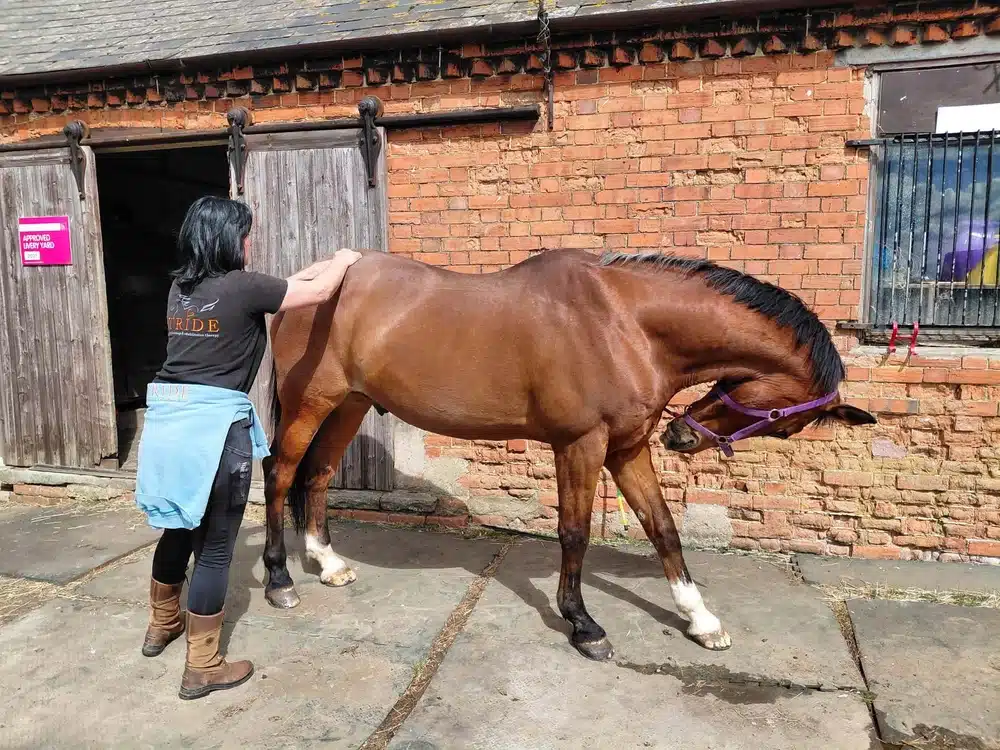
“I think my horse needs a back person…” Understanding the different musculoskeletal professionals
Within minutes, the recommendations start rolling in
“Get a physio.”
“My chiropractor is amazing.”
“You need an osteopath.”
“Try a sports massage therapist.”
Sometimes all four are recommended in the same thread.
The problem is that “back person” isn’t actually a profession. It’s a phrase horse owners have created to describe anyone who works with a horse’s muscles, joints and movement. While it’s understandable, it also creates confusion because those recommendations are often referring to professionals with very different training, qualifications and approaches.
As horse owners, we’re becoming much more proactive about our horses’ health and wellbeing. Regular dental checks, saddle fitting, farriery and nutrition are all widely recognised as important parts of routine care and non-negotiables. Even during the financial crisis, speaking to finalists when interviewing them for the equestrian business awards, they were as busy as ever, which shows the huge shift in attitude towards the importance of regular use of a range of professionals.
Musculoskeletal care has become another important piece of that puzzle, but many owners still aren’t sure who does what.
Should you call a Veterinary Physiotherapist?
Would an Equine Sports Massage Therapist be more appropriate?
What exactly does a Chiropractor do?
And how is that different from an Osteopath?
Then, just when you think you’ve got your head around those professions, someone mentions laser therapy, PEMF, kinesiology taping or a therapy plate. No wonder horse owners feel overwhelmed.

There isn’t one “best” professional
One of the biggest misconceptions is that one profession is somehow better than another. It isn’t. Each profession has developed from a different background, with different training and different ways of assessing and supporting horses. Rather than competing, many of these professionals work alongside one another, often as part of a wider multi-disciplinary healthcare team that may also include your vet, farrier, dentist, saddle fitter and nutritionist. The right professional depends on your horse, the reason you’re seeking help and, in some cases, whether your vet has diagnosed an injury or condition. That’s why it’s so important to understand what each profession actually does.
Veterinary Physiotherapists
Veterinary Physiotherapists specialise in assessing movement, biomechanics and musculoskeletal function. They use a combination of manual therapy, exercise prescription and rehabilitation techniques to help improve movement, strength and long-term function. If your horse is recovering from surgery, rehabilitating after an injury or returning to work following veterinary treatment, a Veterinary Physiotherapist is often an important part of that rehabilitation programme. Many also work with competition horses, leisure horses and veterans to help maintain movement and performance. One of the biggest parts of their role isn’t actually the hands-on treatment, it’s designing bespoke rehabilitation plans. Owners often leave appointments with exercises to complete between visits, helping to build strength, improve balance and encourage correct movement patterns over time.
How do Veterinary Physiotherapists qualify?
There isn’t just one route into Veterinary Physiotherapy. Some practitioners complete a university degree specifically in Veterinary Physiotherapy, while others first qualify as Chartered Physiotherapists before undertaking postgraduate training in animal or veterinary physiotherapy. Several UK universities now offer recognised Veterinary Physiotherapy degrees, including institutions such as Harper Adams University, Hartpury University, Writtle University College (part of Anglia Ruskin University) and others. Chartered Physiotherapists may also complete postgraduate qualifications to specialise in veterinary practice. Like many healthcare professions, learning doesn’t stop after qualification. Most Veterinary Physiotherapists continue developing their knowledge through Continuing Professional Development (CPD), attending courses, conferences and workshops throughout their careers.
Equine Sports Massage Therapists
Equine Sports Massage Therapists (often shortened to ESMTs) focus primarily on muscles and other soft tissues. Massage isn’t simply about relaxation. The aim is to assess muscle function, identify areas of tension or asymmetry and use a range of manual techniques to support muscular health, comfort and performance. Many therapists also provide owners with stretching exercises, management advice and guidance on warm-up and cool-down routines to help maintain muscular health between appointments. Sports massage is often used as part of a horse’s routine management programme, particularly for horses in regular work, older horses or those returning to exercise. Maintenance massages (regularly scheduled massages can form an important part of your horse’s management).
How do Equine Sports Massage Therapists qualify?
This is where things can become a little more confusing. Unlike Veterinary Physiotherapy, there isn’t currently one single qualification route for Equine Sports Massage Therapists in the UK. Instead, there are a number of well-respected training providers offering qualifications at different levels, so if you wish to train as one, it is important to do your research. One of the best-known providers is Equissage Europe, which has been training Equine Sports Massage Therapists for over 30 years. Many practising therapists have completed their education through Equissage Europe, while others have trained with different recognised providers offering Level 3, Level 4 or Level 5 qualifications and diploma programmes. As with any profession, course content, practical experience and qualification levels can vary, so don’t be afraid to ask your therapist where they trained and what qualifications they hold.
Qualifications are only part of the picture, though. The best therapists continue learning long after they’ve qualified. Horses, research and rehabilitation techniques are constantly evolving, and ongoing CPD demonstrates a commitment to keeping knowledge and skills up to date. Both Veterinary Physiotherapists and Equine Sports Massage Therapists play an important role in supporting horses’ musculoskeletal health. Although there is some overlap in the techniques they may use, their training, backgrounds and areas of expertise differ, which is why it’s helpful to understand the reason you’re seeking support before deciding who to contact.
Equine Chiropractors
Chiropractic is another profession that often gets mentioned when owners are looking for a “back person”, but it’s not simply about treating backs. Equine Chiropractors focus on the relationship between the horse’s spine, joints, nervous system and movement. Before any treatment takes place, they’ll usually carry out a detailed assessment, looking at how your horse stands, moves and uses its body. They’ll often watch the horse walk and trot, assess posture, palpate muscles and joints and consider the horse’s history before deciding on the most appropriate approach. Treatment commonly involves specific manual adjustments or mobilisation techniques designed to restore normal joint motion where appropriate. They may also provide advice on exercises, management or changes to your horse’s routine to help support long-term musculoskeletal health.
Like the other professions we’ve discussed, chiropractic isn’t just about what happens during the appointment. A good chiropractor will explain what they’ve found, why they’re recommending a particular approach and what you can do between visits to help your horse.
How do Equine Chiropractors qualify?
In the UK, animal chiropractic is generally a postgraduate qualification. Most practitioners first qualify as either a chiropractor or a veterinary surgeon before completing specialist postgraduate training in animal chiropractic. There are several recognised training providers around the world, including the McTimoney Animal Association pathway in the UK and internationally recognised providers such as Options for Animals College of Animal Chiropractic in the USA. As with all professions, it’s worth asking about qualifications, insurance and ongoing Continuing Professional Development (CPD). Many practitioners continue to develop their skills through additional courses and practical training throughout their careers.
Equine Osteopaths
Osteopathy takes a slightly different approach. Rather than focusing on one area of the body, Equine Osteopaths look at the horse as a whole, considering how muscles, joints, fascia and connective tissues work together to influence movement. One restriction in one part of the body can affect how another part functions, so osteopaths often assess the horse from head to tail before deciding on a treatment plan. Treatment may include mobilisation, stretching, articulation and soft tissue techniques, depending on the individual horse and the findings of the assessment. Many owners like the holistic nature of osteopathy because it looks beyond the obvious area of discomfort and considers how the horse’s entire body is working together.
How do Equine Osteopaths qualify?
Like chiropractic, animal osteopathy is usually a postgraduate qualification. Many practitioners first complete a recognised degree in human osteopathy before specialising through postgraduate animal osteopathy courses. Others may be veterinary surgeons who have undertaken additional osteopathic training. Again, ongoing CPD plays an important role. Horses don’t read textbooks, and every horse presents differently. Continuing education helps practitioners keep up to date with new research, techniques and developments within the profession.

What about laser therapy, PEMF, kinesiology taping and other treatments?
If you’ve started researching musculoskeletal professionals, you’ve probably also come across terms such as PEMF, laser therapy, red light therapy, kinesiology taping, therapeutic ultrasound and therapy plates. These can make things feel even more confusing! The important thing to understand is that these are modalities, not professions. In other words, they’re additional tools that some professionals may use alongside their assessment and treatment, depending on their training and your horse’s individual needs. As there’s so much to cover, we’ll be looking at these therapies in more detail in a separate article, explaining what they are, how they’re used and the questions you should ask before choosing a practitioner.
Depending on which type of professional you’re looking for, you may come across different qualification routes, different training providers, different registers and different associations. Some professions have long-established organisations, while others have several bodies representing different areas of practice.
How do I know where to find these different professionals and whether they have the correct credentials?
You’ll often see acronyms such as RAMP, IAAT, ACPAT, NAVP and many others. Each plays an important role within its own profession, but as a horse owner myself, I know how overwhelming and confusing it can become. That’s one of the reasons I created Equinnect. Equinnect isn’t here to replace those organisations or suggest that one profession is better than another. Instead, it acts as an independent umbrella across a wide range of equestrian professions. When a professional applies to become an Equinnect Verified Member, we check the documents relevant to their profession. That might include qualifications, insurance, Continuing Professional Development (CPD), professional memberships or other profession-specific requirements and they must follow our Equinnect Charter.
The aim is simple: to make it easier for horse owners to choose professionals with confidence, without needing to understand every qualification pathway, register or professional association first. Ultimately, it’s about helping horse owners ask the right questions, understand the different professions and feel more confident about who they’re trusting with their horse.
Find a trusted professional at www.equinnect.co.uk
Follow Equinnect’s socials www.facebook.com/equinnectuk www.instagram.com/Equinnectuk
Are you professional who works in the equestrian industry and want to become a Verified Member of Equinnect?
Join now using the discount code HH30 to enjoy 30% off annual membership.
Head to www.equinnect.co.uk/join
Photo Credit
Stride Equine Massage Therapy using Equine K Taping UK K Tape
